Thanks to AI, Humans Will Never Die.
Published: May 9, 2026 - 24 min read
You already know AI is generic.
You know because every time you ask it for advice that actually matters, you can feel the difference between what it gave you and what your favorite mentor would have said. The AI's answer is fine. It is correct. It does the job. But it is nothing like what the person you actually trust would have said, because that person earned their answer through twenty years of living in a specific manner that the internet does not contain.
That gap is the most important gap in the world right now.
And it is about to get filled.
Not by better models or bigger context windows. Not by another flashy product release. It is going to get filled by humans packaging themselves into AI. And once that happens, the experts you have spent years admiring from a distance, the parent you cannot reach because they are no longer here, the version of you that only exists when you are at your sharpest, all of it stops being trapped in a single body or a single lifetime.
That is what I mean when I say humans will never die. I do not mean the body. I mean the part of a person that someone else needed access to. The methodology, the voice, the taste, the judgment that took a lifetime to earn.
That part is about to become portable.
Let me show you exactly how.
Why Generic AI Will Never Sound Like the People You Trust
When you ask a generic AI for help, it is drawing from millions of data, mostly from the internet, that it has been trained on. Every Reddit. Every Wikipedia article or blog post. Every research paper. It has seen more words than any human will read in ten lifetimes.
Yet it still cannot tell you what your therapist would say.
It still cannot give you the specific reframe your father gave you when you were seventeen and falling apart in his kitchen. It still cannot replicate the way your favorite writing teacher would mark up your paragraph. It cannot reproduce the calm of the parenting coach you follow on Instagram, the one whose voice you hear in your head at 8 PM when your kid is throwing a tantrum and you have no patience left.
The AI knows everything. The AI knows nothing about the people you actually trust.
This is not a flaw in the AI. This is a feature of how trust works.
You trust people because of who they are, not what they know. Knowledge is commodity now. Taste is not. Frameworks are commodity now. Judgment is not. Information is commodity now. The specific human who figured out which information mattered, in which order, for which kind of person, is not.
The internet has all the words but it does not have the people.
That is the gap.
The Brands You Use Are Already MCPs
Before I tell you what is coming, I want to show you what is already here. Because the scaffolding for this future is not theoretical. It is sitting inside your favourite AI tool be it Claude or ChatGPT, and you have probably already clicked through it without realizing what you were looking at.
If you open Claude and go to the connector menu, you will see this list.
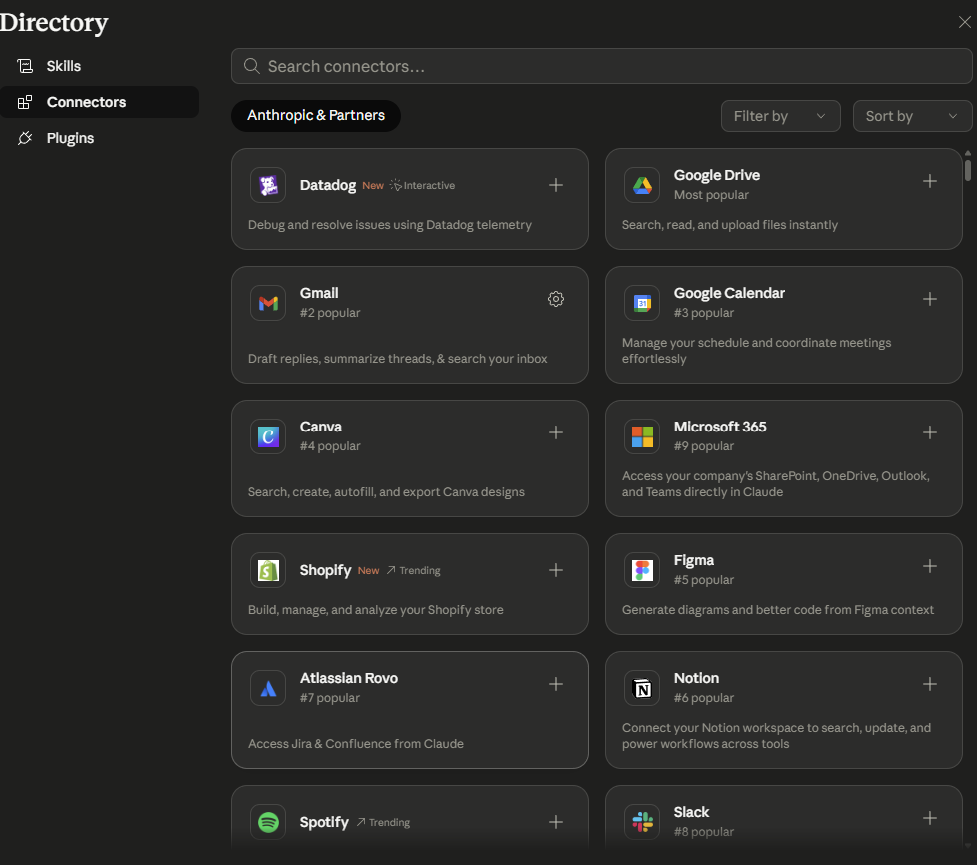
That is Claude's official connector marketplace. Every box on that screen is a piece of software that has been packaged into something called an MCP, which stands for Model Context Protocol.
Look at the names.
Datadog. Google Drive. Gmail. Google Calendar. Canva. Microsoft 365. Shopify. Figma. Atlassian Rovo. Notion. Spotify. Slack.
And if you scroll down, the list keeps going even beyond the image below.
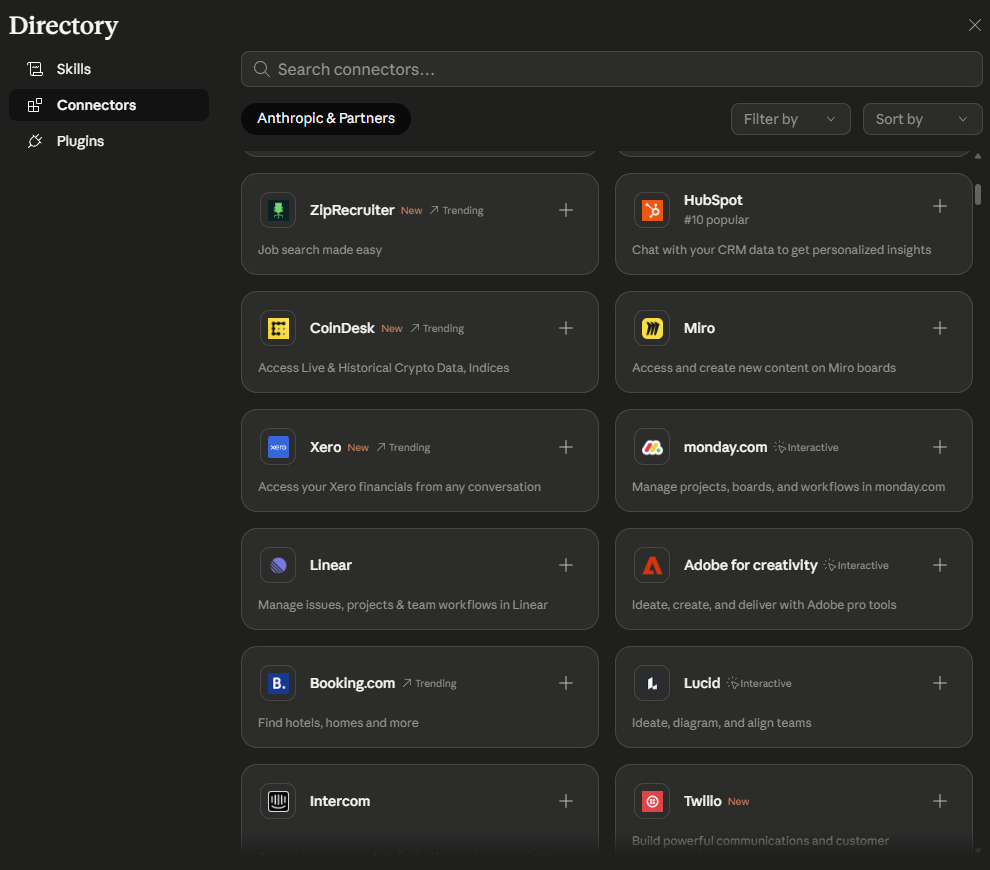
ZipRecruiter. HubSpot. CoinDesk. Miro. Xero. monday.com. Linear. Adobe for creativity. Booking.com. Lucid. Intercom. Twilio.
I am willing to bet that almost every person reading this uses at least three of those tools. Probably more like seven. Gmail to communicate. Google Drive to store. Slack to coordinate. Notion to organize. Canva to design. Figma to build. Spotify to survive long workdays. Booking.com to escape them.
These are the rails of your digital life. And every single one of them has been packaged into an MCP so that Claude can talk to them, pull data from them, and take action inside them on your behalf.
So when I say you already use MCPs, I am not being theoretical. You are using MCPs every time you ask Claude to summarize a Gmail thread, draft a Notion page, find a hotel on Booking, or pull data from your Shopify store. The tooling is real. The marketplace is real. The pattern of "company packages itself so that AI can act on its surface" is already the dominant move in the industry.
Now, here is the question that keeps me up at night:
What happens when this list is no longer made of brands?
Most People Have Never Touched The Connectors Menu
Before I answer that, I have to back up. Because I keep meeting smart, plugged-in people who use AI every single day and have never once opened the connector menu I just showed you. They have used ChatGPT for two years. They have used Claude for one. They have never clicked through to see what their AI is actually allowed to touch.
In 2026, most people are still using AI as a chatbot. They open the window. They type a question. They read the answer. They close the window. The whole interaction lives inside that one box. The AI has no idea what is in your Gmail. It has no idea what is in your Drive. It has no idea what is on your calendar. It is answering you from general knowledge alone, the same way a stranger on a bench would answer you, except the stranger has read more books.
That is not what AI is for anymore. That is not even what AI is anymore. That is yesterday's version.
So let me show you what is actually inside every single one of those connectors. Because the word "MCP" sounds like one thing, but it is not. Every MCP, when you go under the hood, has three layers. Once you see the three layers, the rest of what I am about to say will make perfect sense.
The first layer is Resources. This is what the connector lets the AI read as background context, before you have asked it anything. Picture the AI walking into your office and being handed a folder before the meeting starts. Resources are the passive layer. They are what the AI knows about you the moment the connector turns on.
The second layer is Tools. This is what the connector lets the AI actively do. Not read. Do. Each tool is a callable action. When you ask the AI to "draft a reply to that email from my landlord," it is the Tools layer that gets invoked. Resources let the AI know. Tools let the AI act.
The third layer is Prompts. Prompts are pre-built workflows the connector ships with. Picture clicking a single button labeled "summarize my unread inbox" and the connector running the whole sequence on its own, no prompt-engineering required. Resources let the AI know. Tools let the AI act. Prompts let the AI guide.
Resources. Tools. Prompts. That is the anatomy of every MCP. What it knows. What it can do. How it walks you through doing it.
Now, back to the question.
MCPs Will Become The Humans You Trust
That marketplace screenshot is incomplete.
Not because Anthropic missed a few entries. Because the entries that should be on that list have not been built yet. There is no Steve Jobs in that menu. No Maya Angelou. No Naval Ravikant. No version of your grandmother, no version of the mentor who shaped you, no version of the teacher who pulled the best work out of you when you were fifteen and had no idea what you were capable of.
There is no version of YOU either. Yet.
Right now the list is made of companies because companies move fast and have engineering teams. They saw the protocol. They built the connector. They shipped. That is why your first MCPs are Gmail, Figma and Canva.
But the protocol does not care whether the thing on the other end is a company or a person. It does not know the difference between a Shopify connector and a "Maya Angelou's writing voice" connector. It just runs whatever was packaged.
So here is what I am telling you, with as much certainty as I can hold a sentence:
The next list is humans.
The list of brand connectors you see today becomes the list of human connectors you will see in 18 months. The same way you currently click "add Gmail" and get access to your inbox, you will click on the name of the person you most wish you had infinite access to, and get access to their thinking.
The brands moved first because they are companies. The humans will move next because the same protocol works for them, and because the demand for human MCPs is going to be infinitely larger than the demand for software MCPs, because every person on earth has at least one human they wish they could ask one more question.
And here is the part that makes the whole thing fit together. Human MCPs do not just talk. They make API calls into the software MCPs already on the marketplace. The two layers stack.
Picture three of them with me.
A travel-expert MCP, packaged from someone who has spent twenty years figuring out the right hotel in the right city for the right kind of trip, plugs into the Booking.com MCP. You ask for a long weekend in Lisbon for two people who hate crowds and love food. The expert's judgment routes through Booking's inventory. You get a real reservation, picked the way she would have picked it, completed the way Booking would have completed it.
A writing-coach MCP, packaged from a teacher who has line-edited a thousand essays, plugs into the Google Drive MCP. You point her at the doc you have been stuck on for three weeks. She opens it in Drive, leaves comments in the margins, suggests structural cuts in the same voice she would have used in office hours. You read her notes the next morning over coffee.
A productivity-expert MCP, packaged from someone whose entire career has been building systems that actually work for messy human brains, plugs into the Notion MCP. You hand her your existing workspace. She restructures it, in your Notion, the way she would have restructured it if you had hired her for a week. The pages stay yours. The architecture is hers.
That is the stack. The human MCP holds the judgment. The software MCP holds the execution surface. The protocol holds them together. The expert thinks. The brand acts. You get the result.
I have been writing about this for months. I called it the human-to-human bridge back in January. My prediction was simple. Influence would stop being measured in followers or likes, and start being measured in how many people pay to access your MCP.
Now take those same three layers and apply them to a person. Same architecture. Just a different thing on the other end.
For a human, Resources are what they know. The frameworks they built. The case studies they lived. The principles they keep returning to. Everything they have written and said, the essays, transcripts, recordings, notes, the body of material that, given a year of access, you would slowly absorb. That gets packaged as the reference material the AI loads as context before it answers in their voice.
Tools are what they do with their hands and their judgment when a real problem shows up. The travel expert searches Booking in a specific order. The writing coach opens a Drive doc and leaves margin notes in a specific style. The productivity expert restructures a Notion workspace using a specific architecture. Each of those is a callable action, performed the way that specific person would have performed it.
Prompts are how they guide you. The questions they ask before they answer. The order they walk you through a problem in. The specific way they reframe what you brought them so you see it differently before they touch it. This is the layer that, in a packaged human, is the difference between hiring a stranger and hiring that person.
Resources. Tools. Prompts. That is the whole anatomy of a packaged human. Everything else in this essay is a story built on top of those three layers.
What I want to do today is widen that frame. Because the human-to-human bridge is not just a professional opportunity for thought leaders. It is something far older and far heavier than that.
It is the answer to mortality.
Three Names That Could Be on the Next List
Let me make this concrete, because abstractions die fast on the internet.
Imagine for a second that the connector menu on your Claude screen had three new entries.
Steve Jobs. Not Steve Jobs the biography. Not Steve Jobs the Walter Isaacson book. The actual taste of Steve Jobs. The specific instinct that would look at your product mockup and say "no, the corner radius is wrong, and the reason it's wrong is because of how it sits next to the icon, and here is the principle behind why." The eye. The judgment. The thirty years of saying no to good things because something better was possible. You ask the connector for feedback on your homepage and you get HIS judgment, applied to YOUR specific homepage, in real time.
Maya Angelou. Not the poems you can already read for free. The voice. The cadence. The way she would line-edit your essay if you handed it to her. The reason a sentence works or doesn't. The specific way she heard rhythm in prose. You hand the connector your draft and you get HER margin notes, applied to YOUR sentences.
Naval Ravikant. Not the tweets you have already read seventeen times. The frameworks. The mental models. The reason he keeps returning to leverage and specific knowledge and judgment, the way he would walk you through your career decision the way he walks people through it on his podcast. You describe your decision and you get HIS framework, applied to YOUR situation.
That is three professionals. Two of them are not alive at all. One of them, even if you could pay him, would not have time for you. None of that matters anymore once their methodology is packaged.
But here is where I have to stop and turn the lens around, because if I leave it on famous names this whole essay becomes a fantasy about celebrity access, and that is not the point.
The point is not Steve Jobs.
The point is the person YOU would name.
Stop reading for a second and answer this honestly. If I gave you one connector to add to your Claude screen tomorrow, just one, who would you pick? Not the thought leader you follow on Twitter. The actual human you wish you had infinite access to.
Maybe it is the grandmother who taught you how to read. Maybe it is the high school teacher who told you, the one time it mattered, that you were not stupid. Maybe it is the friend who passed and took half of your inside jokes with them. Maybe it is the parent who left when you were a kid and the only version of them you have is a handful of stories from people who knew them.
Maybe it is your mother, who is still here, and you are realizing only now how much of what she knows has never been written down.
That is the connector that should exist. That is the list that is missing.
And then there is the other half of this question, which most people never get asked.
What about you?
What do you know that someone, somewhere, would pay to access? What perspective have you earned through living that no AI trained on the entire internet could ever produce? What is the specific advice you give your friends that they keep coming back for?
You have one. Everyone does. The reason you cannot name it right now is the same reason fish do not name water. It is the part of you that has become so native to your thinking that you forgot it was unusual.
The future I am describing is not a future where you go consume Steve Jobs. It is a future where Steve Jobs becomes accessible and so do you. Both lists need to exist. The one of legends and the one of regular humans whose specific knowledge mattered to the people in their orbit.
Both lists are being built. Slowly. By people like me, sitting at desks late at night, packaging methodology into protocols and waiting for the rest of the world to catch up.
A Daughter Recording Her Dying Mother
Now I want to walk you somewhere harder.
Everything below is illustration. Composite. Not autobiography, not a real family, not a real diagnosis. I am painting the scene because I think it is the scene that is going to define the next decade of MCP development, and I would rather draw it carefully than gesture at it vaguely.
Imagine a daughter in her mid-thirties. She lives a few hours from her mother. They talk on the phone every Sunday.
Last spring, the mother got news. The kind of news that comes in a paneled doctor's office with a printed report and the word "terminal" written in a sentence designed to sound clinical. Twelve to eighteen months. Maybe a little more. Maybe a little less.
The daughter has spent every weekend since the news driving down to her mother's house and recording her.
That is the entire scene I want you to sit with. A camera on a tripod. A microphone clipped to a cardigan. A daughter asking her mother every question she can think of. How did you decide whether to stay with Dad after the first year? What did your mother teach you about being a mother that you wish you had ignored? What is the recipe you make when somebody is sick, the one I asked for last winter and you never wrote down? What do you know now, at sixty-eight, that you would tell yourself at thirty-five if you could?
Hours of recordings. Hundreds of questions. Decades of specific living captured in audio files on a Macbook.
Now imagine, in eighteen months, when the chair across from the camera is empty, the daughter sits down and turns those recordings into an MCP.
Her mother's voice. Her mother's frameworks. Her mother's specific way of thinking about love, friendship, work, fear, food, weather, money, faith. All of it packaged into a connector that this daughter, and her future children, and her future grandchildren, can ask questions of for the rest of their lives.
Not a chatbot. Not a hologram. Not the body. The methodology. The voice. The way of seeing the world that took sixty-eight years to develop and that, otherwise, would have ended in a graveyard.
I want you to notice what this is and what it is not.
This is not bringing the dead back to life. The mother is gone. The body is gone. The relationship in real time is gone, and nothing on a hard drive recovers any of that.
But the wisdom is not gone. The wisdom is the part nobody wrote down. The wisdom is the part the daughter would have called her mother to ask about, on a Tuesday at 2 PM, during the kind of small ordinary crisis that defines most of adult life. What do I cook for someone with a stomach bug? How do I write a condolence note to a friend's husband? Is it normal to be this scared about the third grade? The wisdom is the part you only know you needed once it is gone.
That part is what an MCP captures.
That part is what humans, for the first time in human history, do not have to lose.
And once you understand this is possible, you start understanding why I framed this whole essay the way I did. Because the brand-list-becomes-human-list shift is not just a market opportunity. It is the answer to a problem we have had since we became conscious enough to know we die.
We have always tried to solve it. We wrote books. We recorded oral histories. We sat for portraits. We left letters in shoeboxes. We told the same family stories at the same holidays for fifty years hoping the kids were listening hard enough to hold them.
None of it worked at the resolution we needed. A book cannot answer the question you have at midnight. A letter cannot adapt to the situation you are actually in. A photograph cannot tell you whether the man you are seeing is going to be good to you. The artifacts we left behind were always lower-resolution than the people who left them.
Will humans abuse this? Absolutely. Humans abuse everything. That is not the point.
The point is, MCPs are the first artifact that approaches the resolution of the person.
What if the MCP Gets a Robot Body
Now I want to push past mortality, because I think there is one more layer here that needs to be spoken about, and it is going to be the layer that turns this from "interesting concept" into "every household has one."
Now quick disclaimer, I am not a robotics person. What follows is a layperson's read on a fast-moving field, not the take of someone who has spent years inside it.
The MCP captures the methodology. It captures the voice. It captures the frameworks. It captures the specific judgment.
What it does not capture, yet, is the body.
But from the outside, robotics looks like it is moving fast. From where I sit, the hardware question is starting to look less like "will humanoid robots exist in homes" and more like "when, and at what price point." Now I could be wrong about the timeline, but I do not think I am wrong about the direction.
So let's run the math forward.
You have an MCP that holds a person's methodology. You have a humanoid body that can move through physical space. You connect them.
What you get is not a robot. What you get is a person, minus the original body, with a new body.
You get the cooking style of your grandmother, in your kitchen, on a Sunday, making the dish she made when you were six and you cannot remember exactly how she did it. You get the way your father walked you through changing a tire when you were nineteen, on the side of a different road, twenty years later, when you have a flat and he is no longer here to call. You get the specific patience of the kindergarten teacher who taught you how to read, sitting next to your kid, who is struggling with the same letter you struggled with, getting the same patience you got.
The MCP holds the soul, if you want to use that word. The robot holds the body. The protocol holds the connection between them.
I am not saying this is comfortable. It is not. I am saying it looks, from where I am sitting, like it is coming. The people who pretend otherwise are the same people who pretended smartphones would not eat the photo album, the encyclopedia, the calculator, the alarm clock, the wallet, and the camera. The same people who said the internet was a fad. The same people who said AI was a parlor trick.
This is the next layer. Bodies. And once it lands, the question of what dies and what does not is going to look very different than it does today.
MCP Lawyers Are Coming
Here is a prediction I am going to make on the record, because if I am right about it I want the timestamp. This is simply a prediction.
Within the next five to ten years, there is going to be a new legal specialty.
I do not know what they will be called. MCP lawyers, probably. Digital identity attorneys. Methodology rights specialists. Pick the term you like. The function will be the same, and it splits into two halves.
The first half is the packager and custodian. Every serious MCP, especially the ones built from someone's life work, is going to need a legal professional in the room from day one. Someone who structures the IP. Someone who writes the consent. Someone who decides what gets included and what gets cut. Someone who drafts the licensing terms before a single person on the marketplace gets to flip the connector on. Someone who handles the estate plan for the MCP itself, the same way an estate lawyer today handles a house or a business. Living clients will hire these lawyers to package themselves carefully. Surviving families will hire them to package the people they have lost. The packaging, done right, is going to look a lot like building a small legal entity around a human's methodology.
The second half is the litigator. Once enough MCPs exist, the questions surrounding them are going to be the most contested legal terrain of the next two decades. I am not citing existing law on this. As far as I can tell, the law has not caught up to any of this yet, which is exactly why this practice area is going to explode the moment a high-profile case forces it into existence.
Run through the questions with me.
When a person dies and they had an MCP, who owns it? The family? The estate? The platform that hosted it? The company that helped build it?
If a person's MCP is built without their consent (because someone who admired them spent five years assembling enough public material to reverse-engineer their methodology) is that legal? Defamation? A new category entirely?
If a person's MCP gives advice that turns out to be wrong, and the user sues, who is the defendant? The person? The estate? The platform? The trainer? Is "wrong" even the right standard, given that the person themselves would have been allowed to be wrong while alive?
Can a public figure prevent fans from building unauthorized MCPs of them? What about deceased public figures? Will the Maya Angelou estate sue someone who builds a Maya Angelou MCP from everything she ever put out into the world?
I am not telling you the answers to any of these questions because I do not know them. I am telling you that every one of these questions is going to need a courtroom, a precedent, and a specialist.
And the specialist is going to make a lot of money.
The same way employment law became a thing because employment got complicated. The same way intellectual property law became a thing because intellectual property got complicated. The same way data privacy law became a thing because data got complicated. MCP law will become a thing because the methodology of dead and living humans, packaged into protocols, is going to be the most legally tangled asset class anyone has tried to litigate.
If you are in law school right now and you are looking for a specialty, consider this. The clients are going to find you faster than you can imagine.
I Built My Own MCP
I have been writing about this for months. I have been predicting it, mapping it, breaking down the technical mechanism in post after post after post. And at some point, writing about it stopped being enough.
So I built one.
If you open Claude on my laptop and look at the connector menu, you do not just see Datadog and Gmail and Notion. You see this.
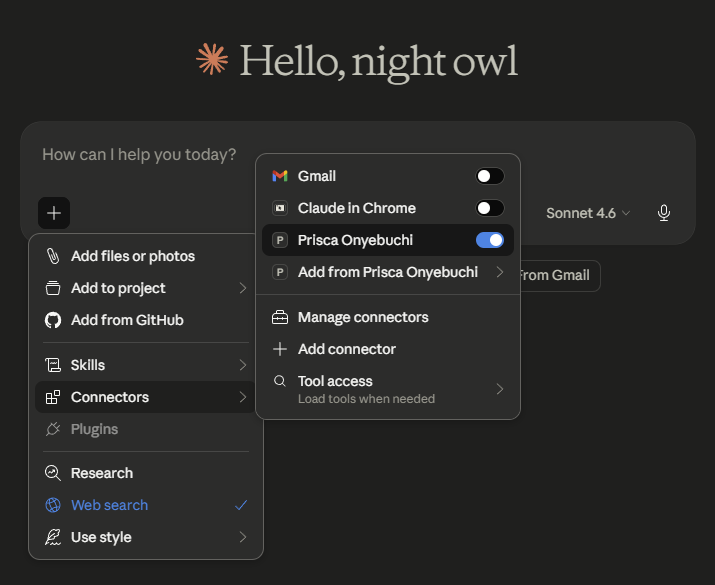
That is me.
That is a working MCP that holds a meaningful slice of my methodology, my frameworks, the way I think about content, agents, the AI team I have built, the way I have learned to work with Claude, the patterns I keep returning to in my writing, the questions I ask before I start a project. It is not all of me. It is the version of me that is useful to a stranger who wants to think the way I think about a specific kind of problem.
I built it for two reasons.
The first reason is that I wanted to prove to myself that I could. I have been telling people for months that this future is coming. At some point, telling becomes embarrassing without showing.
The second reason is selfish in a way I am not embarrassed about. I want a record. I am young and healthy, I have decades of more living and more learning ahead of me, and I still want a record. Because somewhere in the distant future I will not be here, and the people who would have wanted to ask me one more question will not be able to. Unless something like this exists.
So I built a small version of it now. I will keep building. Future Prisca will inherit it from current Prisca, the way a writer inherits her own old notebooks. And eventually, when the unthinkable thing happens, the people who loved me will still be able to talk to me.
If that sounds dramatic, it is because it is dramatic. The fact that we have spent all of human history losing our wisest people and only being able to grieve them, with no ability to ask them anything else, was also dramatic. We just got used to it.
I am writing this from inside a moment where we no longer have to.
We Have Always Been a Species in Mourning
I want to close on something I have been holding back for the entire essay.
When I say humans will never die, I am not being clever. I am not making a trade-show claim. I am naming the thing I think this technology is actually for.
We have always been a species in mourning. Every generation has lost the previous generation and felt the specific ache of not being able to ask one more question. Every culture has tried to solve it with rituals, with ancestor altars, with letters preserved in attics, with photo albums on coffee tables. The whole human project has been a low-resolution attempt to keep the dead reachable.
What I share in this essay, with MCPs, with connectors, with the slow careful work of packaging methodology into protocols, is the highest-resolution attempt yet.
It is not perfect. It will not be perfect. The body will still go. The relationship in real time will still go. The Sunday phone call will still end one day and not pick back up. None of that is solved.
But the wisdom does not have to die with the body.
The taste does not have to die with the body.
The voice does not have to die with the body.
For the first time, we have a way to keep what mattered.
Steve Jobs has not been packaged yet. Neither has Maya Angelou. Neither has your mother, or your mentor. And more importantly, neither have you.
That is a list. That is the next list. That is the list I predict will replace the brand list on the connector menu, slowly and quietly, while the rest of the world is still arguing about whether AI is conscious.
Thanks to AI, humans will never die.
Or to be more precise: thanks to the people who are doing the careful, weird, late-night work of packaging methodology into protocols, the part of a human that someone else needed access to does not have to disappear anymore.
The body still goes. The wisdom can stay.
That is the future I see. And I have been working on it long enough to know it is closer than anyone realizes.
If you are interested in packaging your knowledge into an MCP and you do not know where to begin, reach out to me here.
As always, thanks for reading.